In South Africa’s legal system, individuals facing abuse, threats, or harassment often hear two important legal terms:
Protection Orders,
Criminal Charges.
While these remedies may arise from the same incident, they serve completely different legal purposes. Understanding the distinction is essential for anyone seeking legal protection or considering criminal action.
At Opperman Attorneys, we guide clients through both processes to ensure they receive the correct legal remedy for their situation.
What is a Protection Order in South Africa?
A protection order is a civil court order designed to prevent ongoing or future harm. It is not intended to punish the offender but rather to protect the applicant from further abuse or harassment.
Protection orders are governed by:
Domestic Violence Act 116 of 1998
Protection from Harassment Act 17 of 2011
A protection order may prohibit a person from:
Contacting the complainant directly or indirectly
Entering the complainant’s home or workplace
Harassing, threatening, or intimidating the complainant
Stalking or following the complainant
Once issued by a Magistrate’s Court, a protection order becomes legally binding and enforceable nationwide. Breaching a protection order is a criminal offence and may lead to arrest.
What is a Criminal Charge?
A criminal charge involves the State prosecuting an individual for breaking the law. Unlike protection orders, criminal proceedings are punitive in nature.
Criminal charges are governed primarily by the:
Criminal Procedure Act 51 of 1977
Common law offences (assault, intimidation, crimen injuria)
Sexual Offences legislation where applicable
Common examples include:
Assault or physical violence
Threats or intimidation
Property damage
Sexual offences
Breach of a protection order (separate criminal offence)
The goal of criminal law is to:
Punish unlawful conduct
Hold offenders accountable
Protect society through deterrence
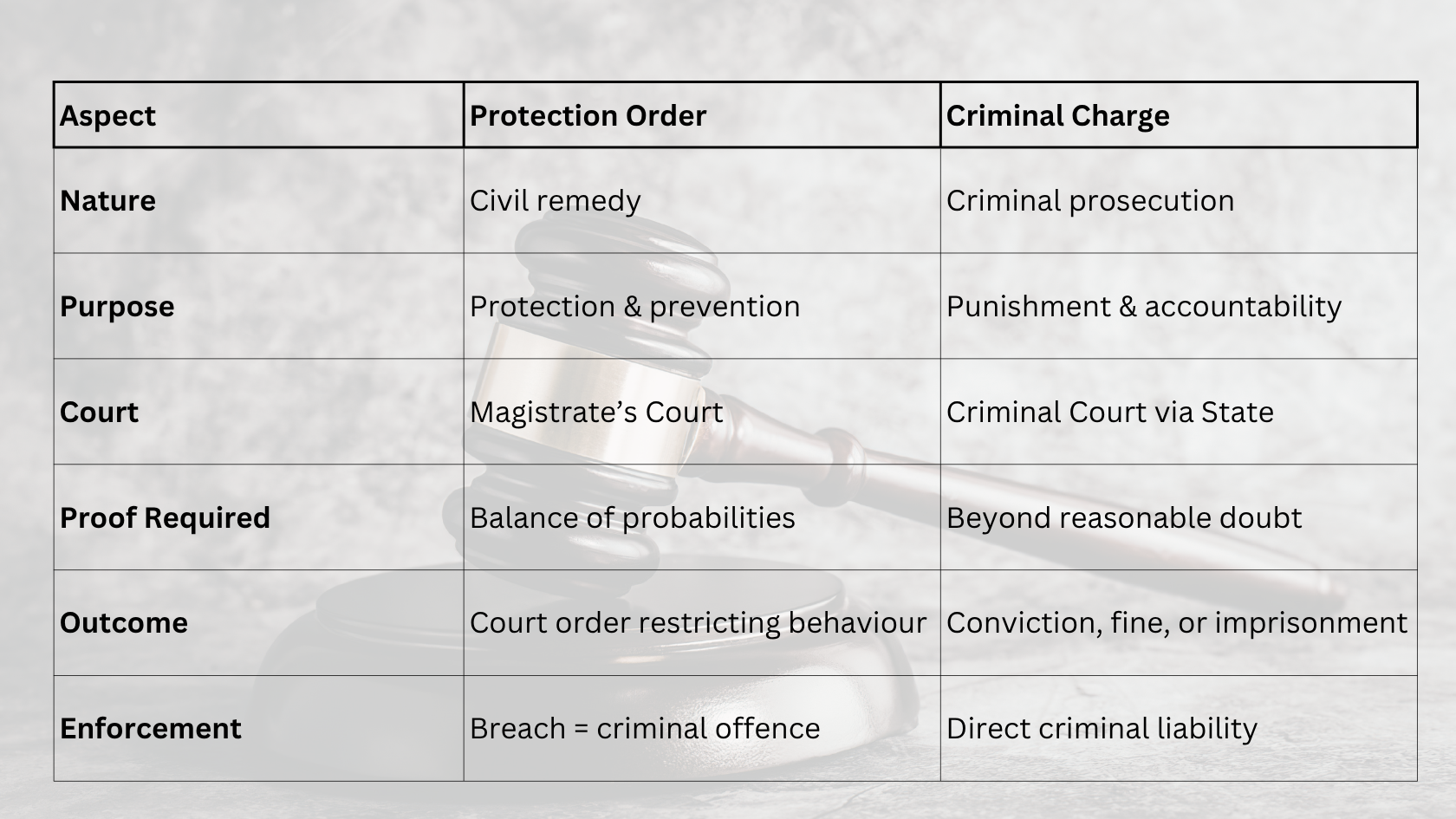
Key Differences Between Protection Orders and Criminal Charges
Can You Apply for Both?
Yes. In South African law, a person can simultaneously:
Apply for a protection order, and
Open a criminal case
These are independent legal processes. A protection order provides immediate safety, while criminal charges address accountability and punishment.
The South African Police Service confirms that a criminal case can be opened regardless of whether a protection order exists.
When Should You Apply for a Protection Order?
A protection order is most appropriate when:
You are experiencing ongoing harassment or abuse
You need urgent legal protection
You want to prevent contact or further harm
It is a proactive legal safeguard designed to stop harmful behaviour before it escalates.
When Should You Open a Criminal Case?
Criminal charges are appropriate when:
A crime has already been committed
There is evidence of assault, threats, or violence
You want prosecution and possible imprisonment
Criminal law focuses on punishing unlawful conduct, not just preventing it.
What Happens if a Protection Order is Violated?
Breaching a protection order is a serious offence under South African law. Consequences may include:
Immediate arrest without a warrant
Criminal prosecution
Fines or imprisonment
This ensures protection orders carry real legal weight and enforcement power.
Relevant South African Legislation
This area of law is governed by:
Domestic Violence Act 116 of 1998
Protection from Harassment Act 17 of 2011
Criminal Procedure Act 51 of 1977
Criminal Law (Sexual Offences and Related Matters) Amendment Act 32 of 2007
Constitution of the Republic of South Africa, 1996 (Section 12 – Freedom and Security of the Person)
Protection orders and criminal charges serve different but complementary roles within South African law. A protection order acts as a shield to prevent harm, while criminal charges act as a sword to enforce justice and accountability.
In many cases, the strongest legal protection involves using both remedies together.
If you are unsure which legal route to take, Opperman Attorneys can assist in assessing your situation and guiding you through the correct legal process.
Conclusion
Protection orders and criminal charges serve different but complementary roles within South African law. A protection order acts as a shield to prevent harm, while criminal charges act as a sword to enforce justice and accountability.
In many cases, the strongest legal protection involves using both remedies together.
If you are unsure which legal route to take, Opperman Attorneys can assist in assessing your situation and guiding you through the correct legal process.
Reference List
Domestic Violence Act 116 of 1998
Protection from Harassment Act 17 of 2011
Criminal Procedure Act 51 of 1977
Criminal Law (Sexual Offences and Related Matters) Amendment Act 32 of 2007
Constitution of the Republic of South Africa, 1996
South African Police Service – Protection Order Procedures
Magistrates’ Court civil protection order procedures