
Understanding Parenting Plans in South Africa

When parents separate, one of the most important questions is often: “How will we continue parenting our child?”
A parenting plan can help parents create clear arrangements about where a child will live, when they will spend time with each parent, how important decisions will be made, and other practical aspects of parenting.
In South Africa, parenting plans are governed primarily by sections 33 and 34 of the Children’s Act 38 of 2005. The law places the child’s best interests at the centre of these arrangements.
What is a parenting plan?
A parenting plan is a written agreement between people who hold parental responsibilities and rights in respect of a child. It sets out how those responsibilities and rights will be exercised.
The Children’s Act allows co-holders of parental responsibilities and rights to agree on a parenting plan. Where they are experiencing difficulties in exercising those responsibilities and rights, they must, before approaching a court for intervention, first try to agree on a parenting plan.
A parenting plan can therefore provide parents with a structured framework for raising their child after separation or during an ongoing parenting dispute.
What can a parenting plan include?
🏠 Where the child will live
The plan can specify where and with whom the child is to live.
This can provide clarity about the child’s primary residence and the practical arrangements between parents.
👨👩👧 Contact with parents and others
A parenting plan can set out arrangements for contact between the child and:
- Each parent;
- Other people who are important to the child; and
- Other relevant persons.
This can include ordinary contact arrangements as well as arrangements for weekends, school holidays and special occasions.
💰 Maintenance
A parenting plan may also address the maintenance of the child.
It is important, however, that parents understand how maintenance obligations interact with other legal agreements and court orders.
🎒 Schooling
Parents can make arrangements concerning the child’s schooling, including how decisions relating to education will be handled.
🙏 Religious upbringing
The plan may also address the child’s religious upbringing.
A parenting plan can therefore be much more than a simple visitation schedule. It can provide a framework for the practical exercise of parental responsibilities and rights.
Why is a parenting plan important?
Separation can create uncertainty for both parents and children.
A carefully prepared parenting plan can help establish clear expectations and reduce disagreements about everyday parenting issues.
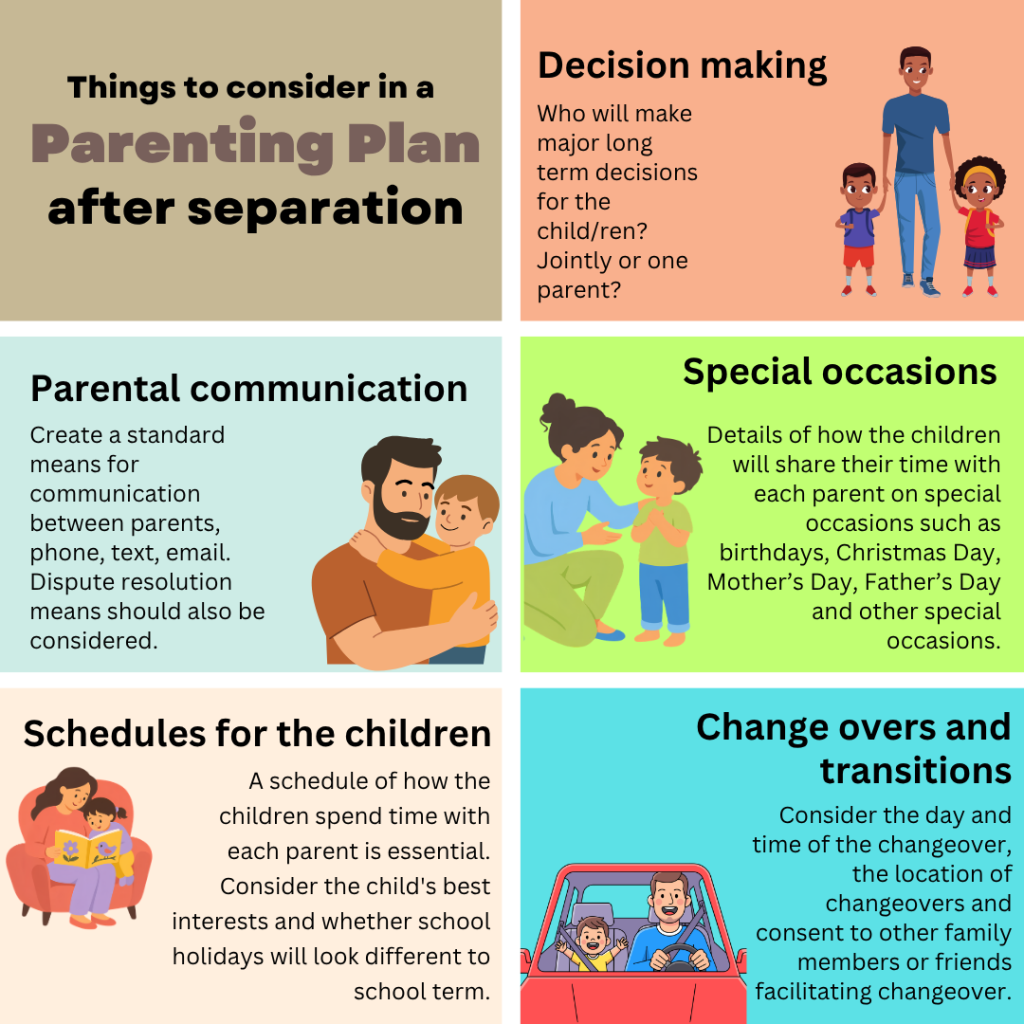
For example, parents can agree in advance about:
- School holidays;
- Birthdays and special occasions;
- Christmas and other holidays;
- Pick-up and drop-off arrangements;
- Communication between the child and each parent;
- School-related decisions;
- Medical decisions;
- Extracurricular activities;
- Travel arrangements; and
- How future disagreements will be addressed.
Not every possible situation can be predicted, but having clear arrangements can help parents navigate many of the practical issues that arise.
The child's best interests come first
A parenting plan must comply with the best interests of the child standard in section 7 of the Children’s Act.
Section 7 requires relevant factors to be considered, including the child’s relationship with their parents and caregivers, the parents’ attitudes towards the child, their capacity to meet the child’s needs, the effect of changes in the child’s circumstances, the child’s age and development, and the child’s physical and emotional security.
The Constitution also provides that a child’s best interests are of paramount importance in every matter concerning the child.
This means a parenting plan should not simply focus on what is convenient for the adults. The arrangements should be considered from the perspective of what is appropriate for the particular child.
What if parents cannot agree?
Parents do not always see eye-to-eye about their children’s care.
The Children’s Act recognises this and provides for assistance when parents experience difficulties in exercising their parental responsibilities and rights.
Section 33(5) provides that, when preparing a parenting plan in circumstances contemplated by section 33(2), the parties must seek:
- The assistance of a Family Advocate, social worker or psychologist; or
- Mediation through a social worker or another suitably qualified person.
The Office of the Family Advocate can assist parents with disputes concerning parental responsibilities and rights and can assist families in reaching agreements through mediation. The service is provided to the public free of charge.
If parents cannot reach an agreement, the Family Advocate may conduct an enquiry and provide a report and recommendation to the court concerning the child’s best interests.
Does a parenting plan have to be in writing?
Yes.
Section 34 of the Children’s Act provides that a parenting plan:
- Must be in writing; and
- Must be signed by the parties.
Subject to the requirements of the Act, it may then be registered with the Family Advocate or made an order of court.
This distinction is important.
A parenting plan that has been made an order of court can only be amended or terminated by an order of court, subject to the provisions of section 34.
A parenting plan registered with the Family Advocate may be amended or terminated by the Family Advocate on application by the co-holders who are parties to the plan.
Can a parenting plan be changed?
Yes. Circumstances can change as children grow.
A parenting arrangement that worked when a child was five may not necessarily work when that child is twelve.
For example, circumstances may change because of:
- A change in school;
- Relocation;
- Changes in working hours;
- Changes in the child’s needs;
- A change in the child’s developmental stage;
- Medical or educational needs; or
- Significant changes in either parent’s circumstances.
The procedure for changing the parenting plan depends on whether it was registered with the Family Advocate or made an order of court.
Parents should obtain appropriate advice before simply changing arrangements that are already formally registered or contained in a court order.
What about the child's views?
Children are not simply passive participants in decisions affecting them.
The Children’s Act recognises children’s participation, and the Department of Justice explains that a child who is of an appropriate age, maturity and stage of development has a right to participate appropriately and express their views in proceedings affecting them.
The child’s views are one of the factors that may be relevant when determining what is in that particular child’s best interests.
Importantly, listening to a child does not mean that the child automatically gets to make the final decision. Their views must be considered within the broader best-interests assessment.
Parenting plans are not only for divorced parents
A common misconception is that parenting plans are only relevant when parents are going through a divorce.
They can also be relevant to parents who:
- Are unmarried;
- Have separated;
- Were never married or lived together;
- Share parental responsibilities and rights; or
- Are experiencing disagreements about how those responsibilities and rights should be exercised.
The Family Advocate’s services are available in disputes concerning parental responsibilities and rights, regardless of whether the parents are married.
What should parents consider before signing a parenting plan?
Before signing, parents should carefully consider whether the agreement is:
Clear
Avoid vague arrangements that can easily lead to different interpretations
Practical
Consider work schedules, school times, travelling distances and the child's normal routine.
Child focused
The arrangements should take the child's age, development, needs and circumstances into account.
Detailed enough
Important areas such as holidays, contact, schooling and decision-making should be addressed where relevant.
Flexible where appropriate
Children's needs change over time, and the plan should provide a workable framework for changing circumstances.
Legally appropriate
Parents should understand whether the plan will be registered with the Family Advocate or made an order of court, and what that means for future amendments.
Need help with a parenting plan?
Every family is different, and the appropriate parenting arrangements will depend on the circumstances of the child and the parents.
If you are separating, experiencing a dispute regarding contact or care, or need assistance understanding your parental responsibilities and rights, obtaining legal advice early can help you understand your options.
Opperman Attorneys assists clients with family and child-law matters.
References
- Children’s Act 38 of 2005, particularly sections 7, 10, 18, 30–35.
Department of Justice – Children’s Act 38 of 2005 - South African Constitution, 1996, section 28.
South African Government – Constitution, Chapter 2 - South African Government – Consult Family Advocate.
Consult Family Advocate - South African Government – What does the Family Advocate do?
Family Advocate information