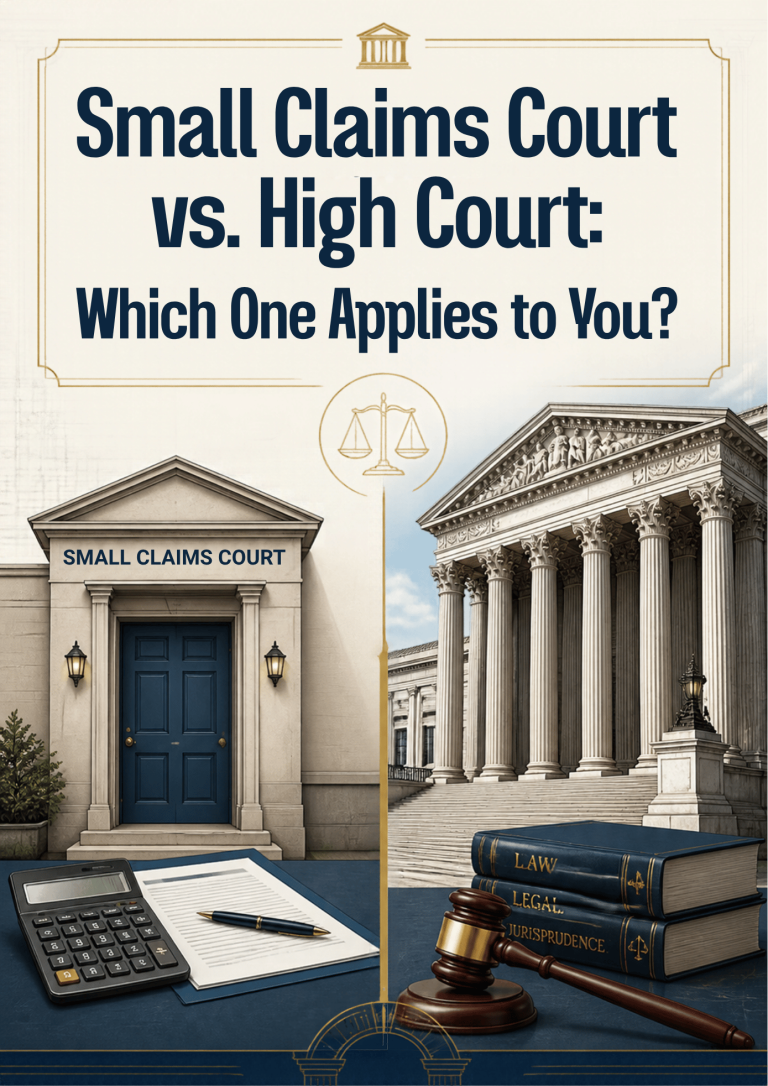
Small Claims Court vs. High Court: Which One Applies to You?

Someone owes you money. A contractor has failed to complete a job. A business dispute has left you out of pocket. You know you may have a legal claim, but where do you start?
In South Africa, choosing the right court is an important part of pursuing a civil dispute. The Small Claims Court, Magistrates’ Court and High Court have different roles, procedures and requirements.
The right option depends on more than the amount of money involved. The nature of your claim, the parties involved and the remedy you need can all influence which court may hear your matter.
Here is what you need to know before taking your next step.
1. Small Claims Court: For certain smaller civil disputes
The Small Claims Court was established to make resolving certain civil disputes simpler and more affordable. It is designed for eligible claims that fall within its monetary limit.
The current monetary limit is R30,000, effective from 1 August 2026.
Who can bring a claim?
A natural person, an individual, may institute an eligible claim. Companies, close corporations and other juristic persons cannot institute claims in the Small Claims Court. However, an individual may bring an eligible claim against a business. Claims against the State, including municipalities and local government, are excluded.
Do you need an attorney?
Legal representation by an attorney or advocate is not permitted during Small Claims Court proceedings. The process is designed to allow individuals to present their own cases, and the clerk of the court can assist with the required procedure. Example: You lent someone R12,000, have proof of the loan and have asked for repayment, but they refuse to pay. If the claim meets the court's requirements, the Small Claims Court may be an appropriate route. Official information is available from the Department of Justice: https://www.justice.gov.za/scc/scc_info.htm
2. Magistrates’ Court: For many everyday civil claims
The Magistrates’ Court is an important option for civil disputes that cannot be dealt with in the Small Claims Court or that require a more formal legal process.
Its jurisdiction depends on the type and value of the claim, the area in which the dispute arose and other applicable legal requirements.
What types of matters may be heard?
Depending on its jurisdiction, a Magistrates’ Court may deal with matters such as:
- Contractual disputes.
- Claims for unpaid debts.
- Certain damages claims.
- Disputes involving goods or services.
- Other civil matters falling within its legal authority.
Unlike the Small Claims Court, parties may generally be represented by legal practitioners, subject to the applicable rules.
Example: A contractor owes you R65,000 under a disputed agreement. The Small Claims Court’s limit may be too low for the full claim, so you may need to consider a Magistrates’ Court or another competent court, depending on the nature of the dispute and the applicable jurisdictional rules.
The Magistrates’ Court is not simply a “middle option” based on the amount claimed. Its legal jurisdiction must be established for the particular matter.
3. High Court: For matters within its broader jurisdiction
The High Court has broader jurisdiction and can hear a wide range of civil matters, including disputes that are unsuitable for the lower courts or that fall within the High Court’s particular authority.
It may deal with substantial or complex litigation, certain urgent applications, constitutional matters within its jurisdiction, reviews and appeals from lower courts, among other matters.
When might the High Court be appropriate?
Depending on the circumstances, a matter may need to be brought in the High Court where:
- The dispute falls outside the jurisdiction of the lower courts.
- The matter involves complex legal issues or remedies requiring a competent High Court.
- An urgent court order is sought and the High Court has jurisdiction.
- The law specifically assigns the matter to that court.
- The matter concerns a review or appeal that falls within its authority.
Example: A business dispute involves complicated contractual issues, substantial financial losses and an application for urgent relief. The High Court may be an appropriate forum, but this must be assessed against the facts, the relief sought and the jurisdictional requirements.
High Court proceedings are generally more formal and can involve substantial legal costs. A larger claim does not automatically mean that the High Court is the correct court.
4. At a glance: How do the courts compare?
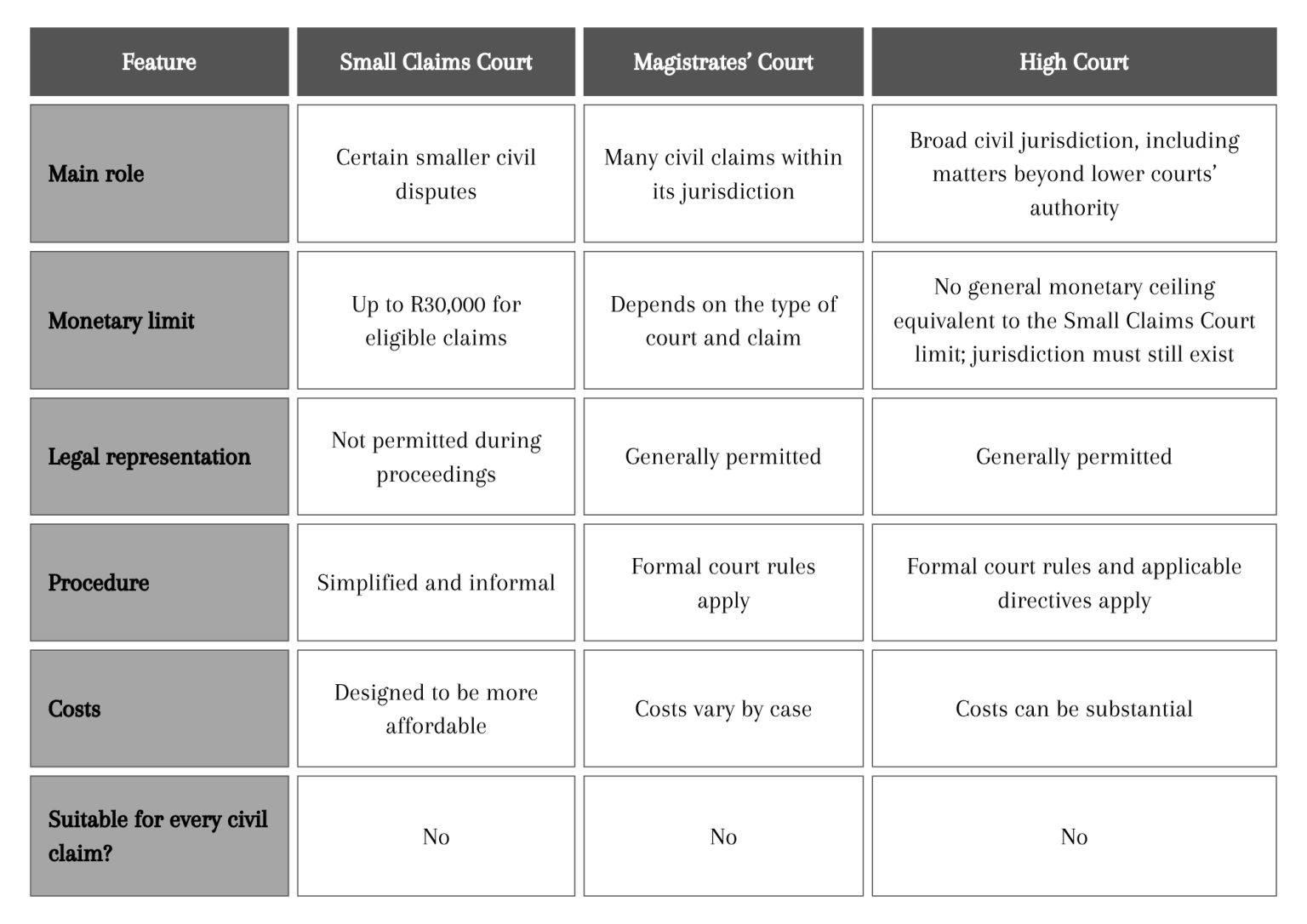
This table is a general guide, not a decision about which court has jurisdiction over a particular dispute.
5. What if your claim is worth more than R30,000?
If your claim exceeds the Small Claims Court limit, you may be able to abandon the excess and claim only R30,000, provided the claim is otherwise eligible.
However, this is a significant decision. Abandoning part of a claim can affect your ability to recover that amount later. You should obtain advice before choosing this route, particularly if the amount involved is substantial or the dispute is complicated.
If you want to recover the full amount, another court with the necessary jurisdiction may be appropriate.
6. What if the amount is small, but the dispute is complicated?
The amount involved is not the only consideration.
A claim may fall below R30,000 but still be excluded from the Small Claims Court because of its subject matter or the remedy being sought. Certain claims, including specified defamation claims, claims against the State and claims relating to divorce, are excluded.
The Small Claims Court may also be unable to proceed with a matter involving legal or factual complexity that it cannot fairly determine.
In such circumstances, you may need to explore another legal process or court with the appropriate jurisdiction.
7. Before you choose a court, ask these five questions
Before starting legal proceedings, consider the following:
1. What exactly am I claiming?
Are you seeking repayment, damages, delivery of property, enforcement of an agreement or another remedy?
2. What is the value of my claim?
Calculate the amount carefully and keep supporting documents.
3. Who is bringing the claim, and against whom?
The legal status of the parties may affect whether the Small Claims Court is available.
4. Is this type of dispute allowed in the court I am considering?
Certain claims are excluded, regardless of their value.
5. What evidence do I have?
Contracts, invoices, messages, proof of payment, photographs and correspondence may help establish your case.
If you are unsure about any of these questions, seek legal advice before issuing court papers or abandoning part of your claim.
The right court can make a difference
Choosing the right court is not just about finding the cheapest or quickest option. It is about identifying a forum that has the legal authority to hear your dispute and grant the remedy you need.
The Small Claims Court can offer an accessible route for certain eligible claims up to R30,000. The Magistrates’ Court handles many other civil disputes, while the High Court has broader jurisdiction for matters that fall within its authority.
If you are uncertain where your matter belongs, get advice before taking action. Understanding your options early may help you avoid unnecessary expense, procedural difficulties and delays.
Need assistance with a civil dispute?
Opperman Attorneys can help you understand your legal position and consider the appropriate steps for your circumstances.
Telephone: 082 780 3708
Email: chenique@opperman.law
Office: 113 Commissioner Street, Krugersdorp, Gauteng
This article is intended for general information purposes only and does not constitute legal advice. Court jurisdiction and procedure depend on the particular facts, the relief sought and the applicable law. Obtain advice about your individual circumstances.
References
- Department of Justice and Constitutional Development — Small Claims Courts: https://www.justice.gov.za/scc/scc_info.htm
- Department of Justice and Constitutional Development — Increase in Small Claims Court monetary jurisdiction to R30,000, effective 1 August 2026: https://www.justice.gov.za/m_statements/2026/20260722-SCC-Monetary-Jurisdiction-R30000.html
- Small Claims Courts Act 61 of 1984.
- Magistrates’ Courts Act 32 of 1944.
- Superior Courts Act 10 of 2013.
- Department of Justice — Courts in South Africa: https://www.justice.gov.za/about/sa-courts.html