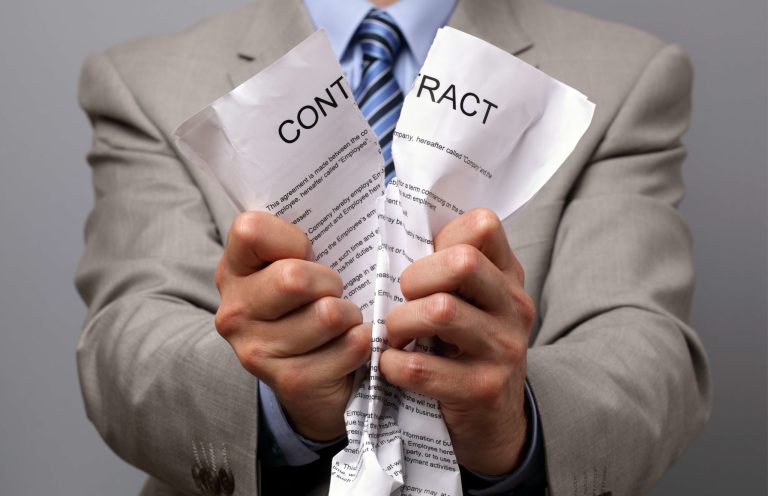
What Happens If Someone Breaches a Contract in South Africa?

You agreed on a price. You signed the contract. You held up your end of the deal, but the other person did not.
Perhaps a contractor took your deposit and never completed the work. A supplier failed to deliver goods as promised. Or a business partner suddenly refused to honour an agreement.
When one party fails to meet their contractual obligations, it may amount to a breach of contract. But what can you do about it? Can you cancel the agreement, demand your money back or take the other party to court?
The answer depends on the terms of the agreement, the nature of the breach and the legal remedies available to you.
1. First, what counts as a breach of contract?
A breach occurs when a party fails to perform an obligation required by a valid contract.
- This may happen when someone:
Fails to pay: A customer does not pay an invoice by the agreed deadline. - Fails to deliver: A supplier does not deliver goods or services as promised.
- Performs inadequately: A contractor completes work that does not meet the agreed specifications.
- Acts contrary to the agreement: A party does something the contract prohibits.
- Indicates they will not perform: A party makes it clear that they do not intend to honour their contractual obligations.
Not every disagreement automatically amounts to a breach, and not every breach gives the other party an immediate right to cancel. The actual wording of the agreement and the surrounding circumstances matter.
2. A practical example: When a contractor fails to finish the job
Imagine you hire a contractor to renovate your kitchen for R80,000. You pay a deposit and agree that the work will be completed by a particular date.
The deadline passes. The kitchen is unfinished, the contractor stops responding to your messages, and you are left wondering what to do next.
You may feel tempted to cancel immediately, demand a full refund or hire someone else and send the original contractor the bill.
Before taking action, consider these questions:
- What exactly does the written agreement say
- Has the contractor breached a specific obligation
- Does the contract provide a procedure for addressing the breach
- Is the breach serious enough to justify cancellation
- Can the contractor still fulfil the agreement
- What financial loss have you actually suffered?
These questions help establish which remedy may be appropriate and reduce the risk of taking action that could create a further dispute.
3. What legal options are available?
South African contract law provides several possible remedies. The most suitable option depends on the facts of the matter, and some remedies cannot be pursued together as final, inconsistent outcomes.
Option 1: Insist that the contract be fulfilled
You may be able to require the other party to perform their contractual obligations. This is commonly known as specific performance. For example, if a supplier has failed to deliver goods but is still able to do so, you may seek to enforce the delivery obligation rather than end the agreement. A court may grant an order for performance where appropriate, but this is not automatic. The court considers the circumstances and whether the requested order is suitable and possible.
Option 2: Cancel the contract
In some circumstances, the innocent party may be entitled to cancel the agreement. However, cancellation is not always available simply because something has gone wrong. The breach may need to be sufficiently serious, or the contract may need to provide a valid cancellation right that applies to the situation. The agreement may also require the affected party to give written notice and allow the other party time to remedy the breach. Important: Do not assume that you can cancel any contract immediately. An unlawful cancellation may expose you to a claim by the other party.
Option 3: Claim damages
If a breach has caused you financial loss, you may be able to claim damages, provided the legal requirements are met. The purpose of contractual damages is generally to place the innocent party, as far as money can, in the position they would have occupied had the contract been properly performed. For example, if a contractor's breach forces you to pay more to complete the agreed work, the additional cost may be relevant to a damages claim. Whether that amount is recoverable depends on the evidence, the contract and the applicable legal principles. Keep invoices, quotations, proof of payment and other records that help demonstrate your loss. A claim for damages is not simply a claim for any amount you feel is fair.
Option 4: Seek an appropriate court order
If the dispute cannot be resolved, legal proceedings may be necessary. Depending on the circumstances, a court may be asked to enforce contractual obligations, determine whether cancellation is justified or award damages. The remedy sought must be carefully considered. For example, insisting on performance and cancelling the contract are generally alternative approaches, although damages may sometimes be claimed alongside an appropriate remedy.
4. Should you send a letter of demand?
A letter of demand is often a useful step before commencing legal proceedings.
It sets out the alleged breach, explains what the other party is required to do and gives them an opportunity to respond or remedy the problem. It can also create a written record of your attempt to resolve the dispute.
A letter of demand may include:
- The details of the agreement.
- The obligation that has allegedly been breached.
- A summary of the relevant facts.
- The action required to address the breach.
- A deadline for responding or complying, where appropriate.
- The consequences that may follow if the matter remains unresolved.
The deadline should be reasonable and consistent with the contract and applicable law. If the agreement prescribes a particular notice procedure, that procedure should be considered before a demand is sent.
A letter of demand does not guarantee payment or compliance, but it may help clarify the dispute and provide an opportunity for resolution without litigation.
5. What evidence should you keep?
If you believe someone has breached a contract, start organising your records as soon as possible.
Useful evidence may include:
- A signed contract or written confirmation of the agreement.
- Emails, messages and letters between the parties.
- Invoices, receipts and proof of payment.
- Delivery notes, quotations and project timelines.
- Photographs or reports showing incomplete or defective work.
- Records of additional expenses or financial losses.
- Copies of any notices or demands already sent.
Even where an agreement was made verbally, relevant messages, payment records and witness information may help establish what was agreed. Some types of contracts are subject to specific legal formalities, so whether a particular agreement is enforceable must be assessed on its facts.
6. What if the other party refuses to cooperate?
If reasonable attempts to resolve the dispute fail, you may need to consider formal legal action.
The appropriate process will depend on the amount in dispute, the type of claim, the terms of the contract and which court or other forum has jurisdiction.
Before proceeding, consider the likely costs, available evidence, prospects of success and whether the other party will be able to satisfy a judgment. Winning a case does not necessarily mean that payment will be made immediately.
There may also be alternative dispute-resolution options or a relevant ombud or consumer-protection process, depending on the nature of the contract and the parties involved.
For consumer agreements, the Consumer Protection Act 68 of 2008 may apply in certain circumstances. It does not apply to every contract or every dispute, so the parties’ status and the nature of the transaction must be considered.
7. Is there a time limit for taking legal action?
Yes. Contractual claims may be affected by prescription under the Prescription Act 68 of 1969.
Many ordinary contractual debts are subject to a three-year prescription period, but the applicable period and the date on which it starts running depend on the nature of the claim and the relevant legal rules. Different periods may apply to certain debts.
Do not assume that negotiating with the other party automatically stops prescription from running. If a dispute has been ongoing for some time, obtain legal advice promptly so that important deadlines are not missed.
Before you take your next step
If someone has breached a contract, avoid making rushed decisions based solely on frustration or verbal assurances.
Instead:
Read the agreement carefully.
Identify the obligation that has not been fulfilled.
Gather the supporting documents and evidence.
Check whether the contract sets out a notice or dispute-resolution procedure.
Consider which remedy is legally available and appropriate.
Seek legal advice before cancelling the contract or commencing proceedings.
Taking the correct steps early may help you protect your rights, limit further losses and make a more informed decision about resolving the dispute.
Need advice about a contract dispute?
A breach of contract can affect your finances, business operations and peace of mind. Understanding your rights and the remedies available can help you decide how to proceed.
Opperman Attorneys can assist you in understanding your legal position and considering the appropriate steps for your circumstances.
Contact Opperman Attorneys
This article is intended for general information purposes only and does not constitute legal advice. The outcome of a contract dispute depends on the specific agreement and facts of the matter. Obtain advice on your individual circumstances.
References
Rademeyer v Ferreira [2024] ZACC 24, Constitutional Court of South Africa. Available at: https://www.saflii.org/za/cases/ZACC/2024/24.html
Basson and Others v Hanna [2016] ZASCA 198, Supreme Court of Appeal of South Africa. Available at: https://www.saflii.org/za/cases/ZASCA/2016/198.html
Prescription Act 68 of 1969. South African legislation governing prescription of debts.
Consumer Protection Act 68 of 2008. Available at: https://www.gov.za/sites/default/files/32186_467.pdf